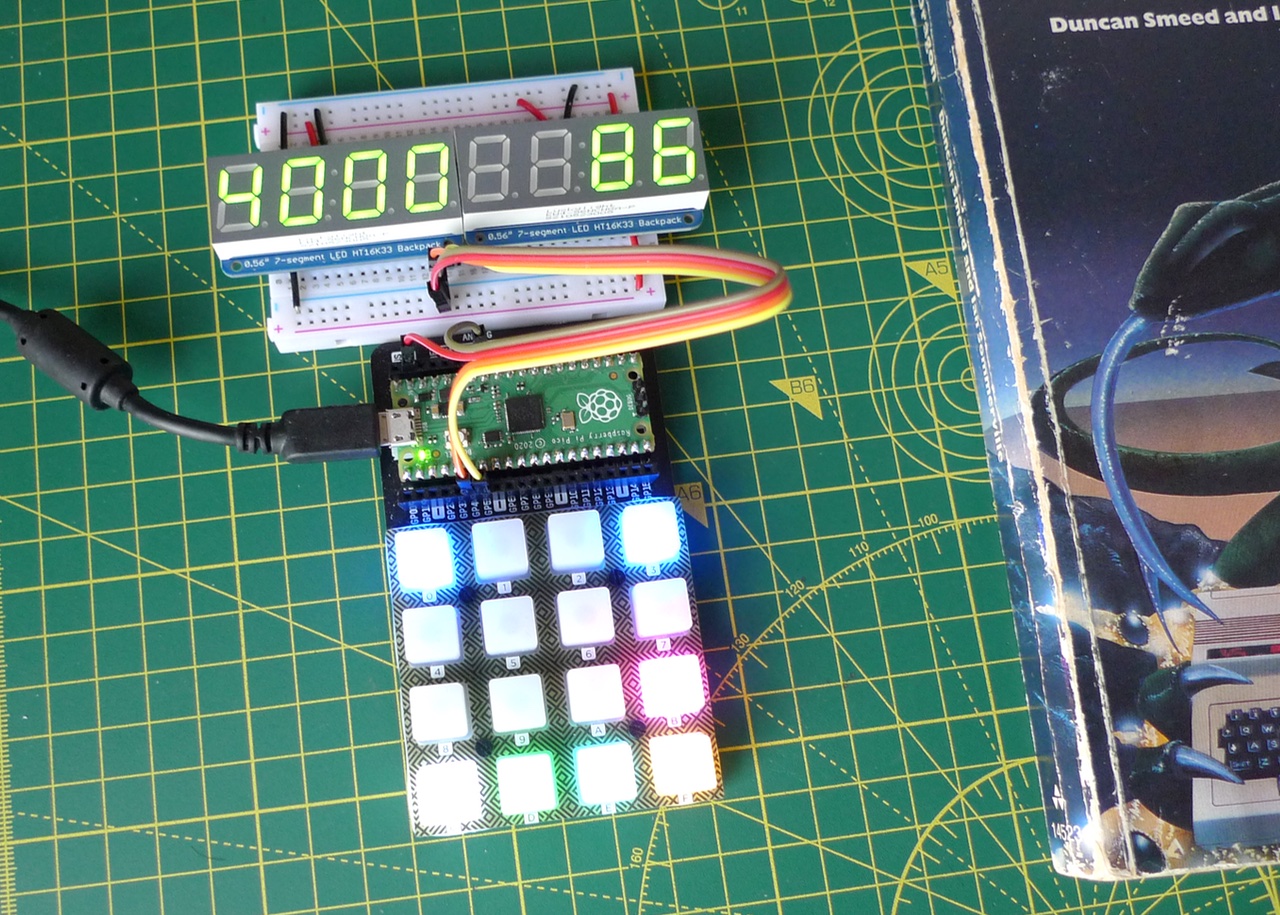
My Raspberry Pi Pico-based Motorola 6809 emulator uses the RP2040’s built-in serial-over-USB functionality to receive machine code sent from a host computer. The 6809 and its support code is written in C, but can you make use of the same process under Python? Yes, you can, and here’s an easy way to do it.
Continue readingBuild a Raspberry Pi Pico WiFi IoT Device
Last Summer, I explored using the Raspberry Pi Pico as the basis of a cellular IoT device. That done, I wanted to try out WiFi connectivity. To do so, I ordered a Pimoroni PicoWireless.
Continue readingRecreating the Motorola 6809 in a Raspberry Pi Pico
This is a little project I’ve been working off and on now for some time. It’s one of those efforts where you do a heap of work and then leave it alone for months on end while you go off and do something else entirely. Eventually you come back and do a little more, and then something else distracts you. But you know you’ll complete it in the end, and the journey is as much fun as reaching the destination.
Continue readingRaspberry Pi Pico development on the iPad Pro: almost, but not quite there
I recently upgraded my ageing iPad to a new iPad Pro 11. This has a USB C port, and I immediately wondered if I could use this to connect a USB C equipped Raspberry Pi RP2040-based device like the Adafruit Feather RP2040, and do development on the iPad rather than a Mac. The answer is a cautious ‘yes’, provided you can work to a very specific limitation: your RP2040-side application environment has to be CircuitPython.
Continue readingProgram games on the Pimoroni PicoSystem
A wee while back I ordered a Pimoroni PicoSystem to try out. It’s a small handheld games console based on the Raspberry Pi RP2040 microcontroller, and it sports both classic joypad controls and a 240 x 240 16-bit colour display. I gave my first impressions in an earlier post. Here’s what I think after spending some time porting my Raspberry Pi Pico version of the 1980s 3D shooter Phantom Slayer to the unit.
Continue readingThe microprocessor turns 50: this is how it was conceived
Almost all of the technology we use today is based on the microprocessor. There can be few electrical devices, really only the most basic, whose capabilities are not now defined by software running on a microprocessor chip within. Those chips’ designs are different, and some incorporate much more ancillary functionality than others, but their fundamental architecture is the same: a set of logic and arithmetical units operated in a predetermined sequence by a set of program instructions. The result: a general purpose machine that can be changed to do almost anything — you just keep feeding it different programs. Car engine management; central heating control; TV interface; games console; washing machine cycle… you name it, they use the same chips, just run different code.
Continue readingHow to send data to a Raspberry Pi Pico via USB
Do you need to transfer data to and from a Raspberry Pi Pico, or similar RP2040-based board, connected to your computer by USB? Here’s a neat way to achieve it without any tedious mucking about with the USB stack. Apart from a couple of questions on the Raspberry Pi Forum, there’s not much in the way of documentation, so here’s a write-up.
Continue readingFirst look: Pimoroni’s PicoSystem hackable handheld games console
I’ve had my eye on the PicoSystem, the Raspberry Pi RP2040-based games console platform, for some time. It surfaced back in the Spring and was long marked “coming soon”. But now it’s here, mine showed up yesterday while I was at work, and this morning I’ve been messing about with it.
Continue readingClive Sinclair (1941-2021) Part three — resurgam
In part one we saw how the young Clive Sinclair created Sinclair Radionics — twice — and built it into a successful business that launched hi-fi products in the 1960s and the first ever pocket calculator in 1972. In part two, we investigated the genesis of the Radionics microcomputer. Read on to learn what occurred when Radionics finally went under, and how the ZX80 came about…
Continue readingClive Sinclair (1940-2021) Part two — Radionics’ last, great hope: the microcomputer
In part one, we saw how the young Clive Sinclair created Sinclair Radionics — twice — and built it into a successful business that launched hi-fi products in the 1960s and the first ever pocket calculator in 1972, but soon suffered badly as its digital watch efforts foundered and competition crushed its calculator sales. Read on to learn how Radionics met its end, but (almost) gave birth to a new microcomputer…
Continue reading