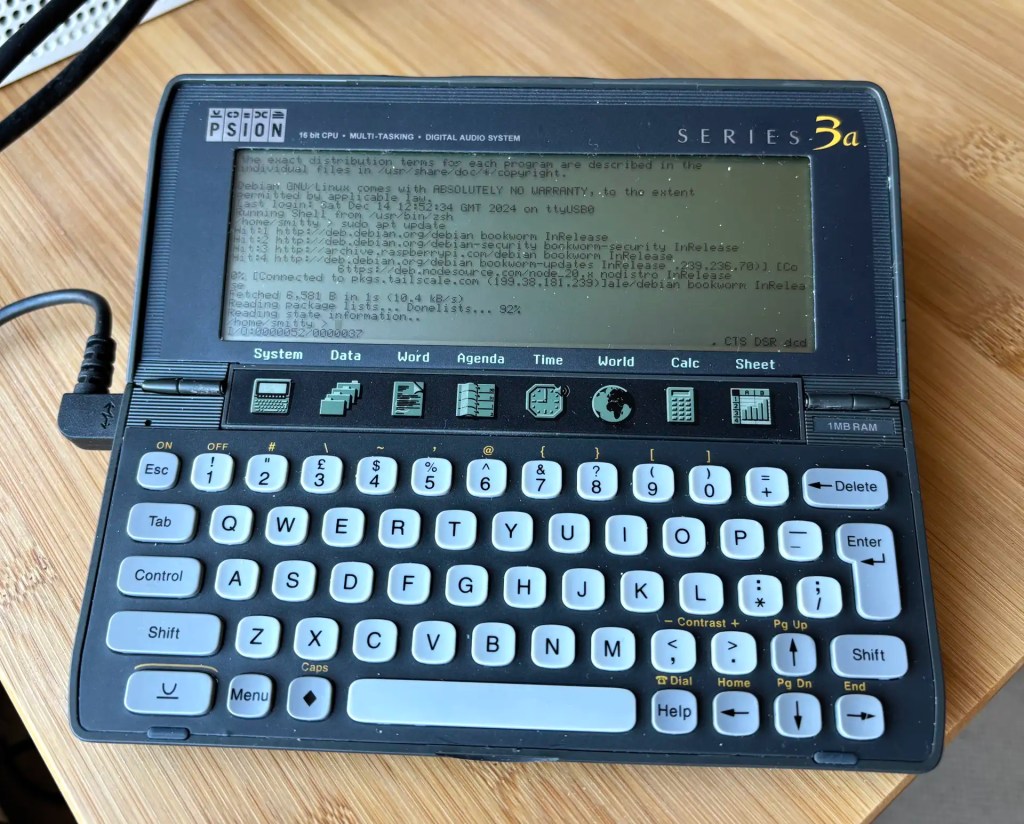
Recap I have acquired a UK-made Psion Series 3a palmtop. I’ve connected it to my Mac. My next goal is to connect the 3a to the Internet for email. But first… yes, I got distracted: having connected the 3a to a Mac, what about a Raspberry Pi? Could I do more with it than transfer files?
Darn right, I can. I can use it to control my headless server.
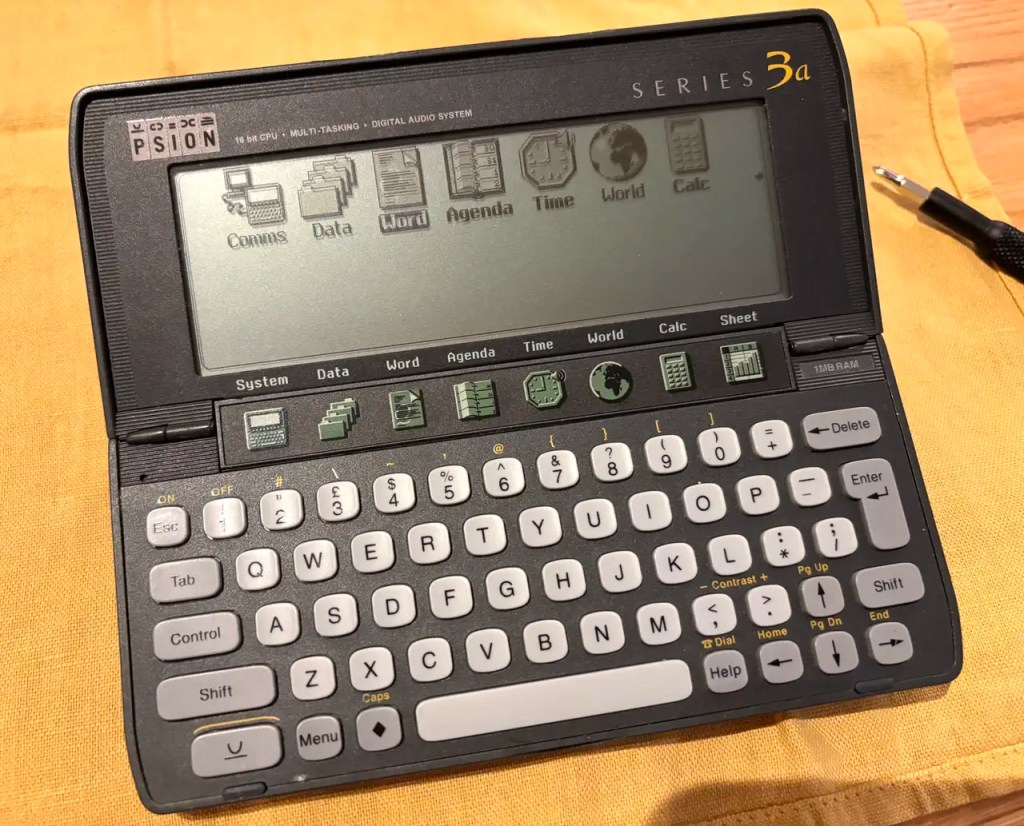
I have a soft spot for the technology of my younger days. In the mid-1990s, for example, I was in my late twenties and one of the machines I used for a time — all my MacWorld Boston 1994 coverage was written on one — was the Psion Series 3a. Pitched as a portable personal organiser, it was a palmtop PC running a 16-bit OS, SIBO aka EPOC 16, on an x86 CPU.
Palm computing: the Psion Series 3a
Running, I might add off a couple of AA batteries (with a coin cell to maintain RAM disk contents when the main pair were replaced) that could last for at least a month. No backlight on the monochrome LCD, though, which makes the device’s use in dim lighting tricky. Strong, over-the-shoulder lighting is essential.
This is a little project I’ve been working off and on now for some time. It’s one of those efforts where you do a heap of work and then leave it alone for months on end while you go off and do something else entirely. Eventually you come back and do a little more, and then something else distracts you. But you know you’ll complete it in the end, and the journey is as much fun as reaching the destination.
Almost all of the technology we use today is based on the microprocessor. There can be few electrical devices, really only the most basic, whose capabilities are not now defined by software running on a microprocessor chip within. Those chips’ designs are different, and some incorporate much more ancillary functionality than others, but their fundamental architecture is the same: a set of logic and arithmetical units operated in a predetermined sequence by a set of program instructions. The result: a general purpose machine that can be changed to do almost anything — you just keep feeding it different programs. Car engine management; central heating control; TV interface; games console; washing machine cycle… you name it, they use the same chips, just run different code.
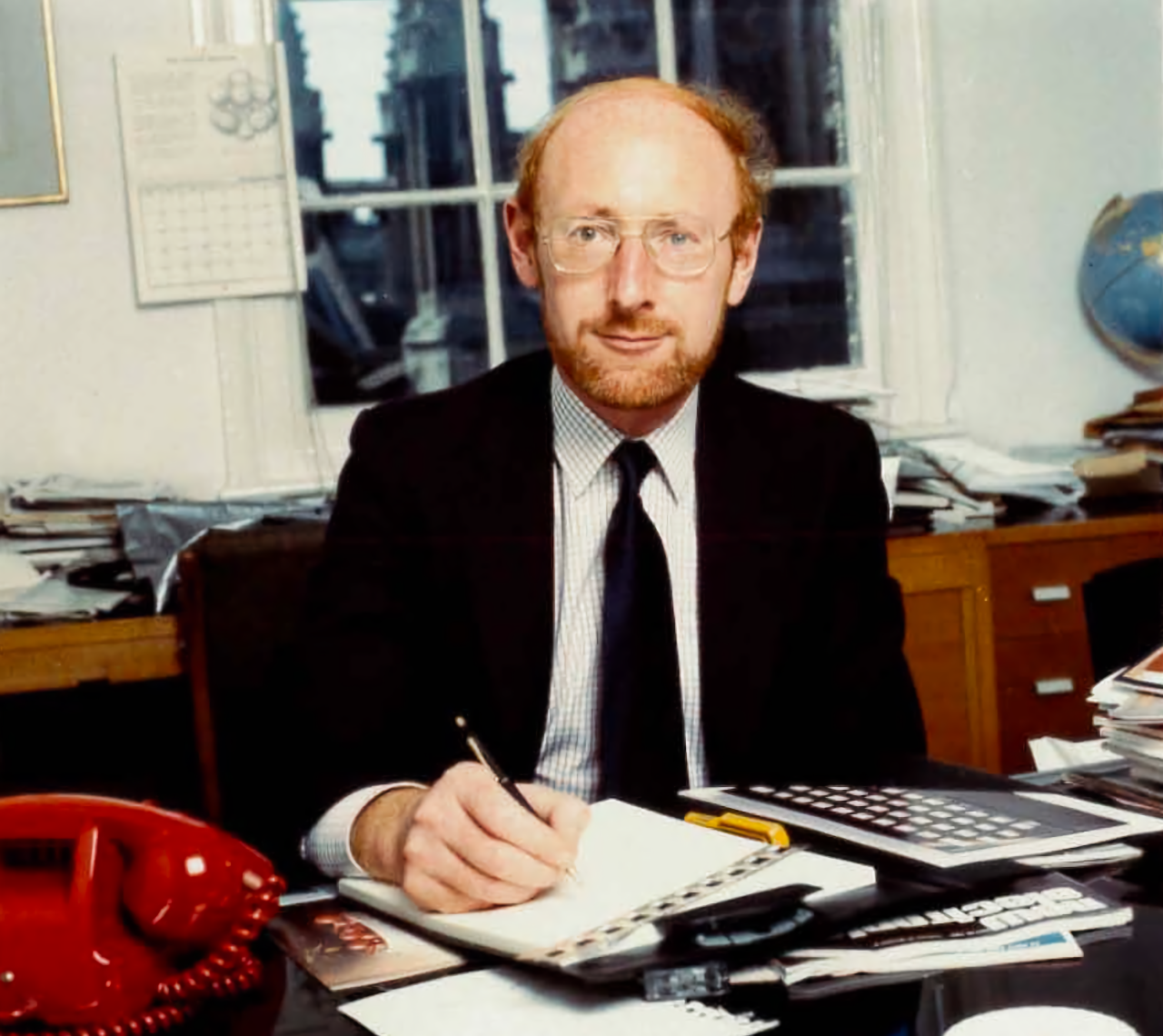
In part one we saw how the young Clive Sinclair created Sinclair Radionics — twice — and built it into a successful business that launched hi-fi products in the 1960s and the first ever pocket calculator in 1972. In part two, we investigated the genesis of the Radionics microcomputer. Read on to learn what occurred when Radionics finally went under, and how the ZX80 came about…
In part one, we saw how the young Clive Sinclair created Sinclair Radionics — twice — and built it into a successful business that launched hi-fi products in the 1960s and the first ever pocket calculator in 1972, but soon suffered badly as its digital watch efforts foundered and competition crushed its calculator sales. Read on to learn how Radionics met its end, but (almost) gave birth to a new microcomputer…
Clive Sinclair formed the first company to bear his name in 1961 while he was a 21-year-old electronics journalist. He had received no formal education in the subject, but as a highly intelligent autodidact, he had developed a passion for electronics during his teens. He also had an entrepreneurial bent, and even in his youth spotted a business opportunity in designing and selling kits to fellow electronics enthusiasts.
Nearly half a century ago, Clive Sinclair’s Sinclair Research made history. It released the ZX81, one of the key home computers of the 1980s, as the first low-cost micro available to High Street shoppers. And you can express your love of early 80s tech with my latest retro-wear: the ZX81 keyboard shirt.
Phantom Slayer, the 1982 computer game I’ve restored on the Raspberry Pi Pico, has been updated to version 1.0.1 to give the titular spectres some extra smarts as they navigate the game maze in pursuit of the player.





 smittytone messes with micros