Author Archives: smittytone

Unknown's avatar

About smittytone

Tech Author and Writer

Ancient Palmtops as serial terminals, Part 2: the Psion 5mx and the homelab

Last year, I performed some jiggery-pokery on my headless Raspberry Pi-based HomeLab to allow my veteran Psion 3a palmtop to be used as a serial terminal for those times when SSH-ing in was not an option. The age of the 3a meant it was a sub-optimal experience, but it was usable. I recently acquired a Psion 5mx, released half a decade after the 3, and put it to the same task.

A Psion 5mx running Hermes to show a Raspberry Pi serial terminal. Image © Tony Smith (@smittytone)

The experience is much better, but I needed to tweak the PI-side settings to get results.

Continue reading

Unearthing macOS’ Uniform Type Identifiers

The Uniform Type Identifier — UTI for short — is an interesting means to map files to the type of data they contain. macOS uses UTIs to work out what kinds of file an application can open to view or edit. My Preview… apps rely on UTIs to indicate their interest in certain file types. The system uses that information to pass files to my application extensions when a user previews a file using QuickLook. Generally, they’re hidden from users.

utitool 1.2.0 in action

There’s a flaw in the system, however. A UTI might indicate the content a file might be expected to contain, but how does the system connect a file to a UTI? By using its file extension. But while UTIs are unique, file extensions are not, and this is where the trouble begins.

Continue reading

Hoard of the rings: extracting data from Colmi BLE annular activity trackers

I’m not especially a fan of the ‘quantified self’, the notion that I should continuously record massive amounts of data about my daily life and physiological state. But I am keen on Bluetooth LE communications, and this reason, not the former, is why I acquired a Colmi R02 “smart ring” from the PRC.

Colmi R02 smart ring. Image © 2025 Tony Smith

And all for a mere £6.24 including postage and packing. Barg!

The ring contains a tiny microcontroller and BLE radio, plus an accelerometer for step counting, a blood oxygen reader and a heartbeat sensor. It’s powered by a battery recharged using a tiny magnetic jack that you plug into any USB adaptor. Wee it may be, but the 17mAh battery will give you around five days’ usage on a full charge. From its size, the MCU looks like it’s the BlueMicro RF03, but the precise type is not stated in the ring’s specs.

Continue reading

How I went kicking and screaming from AppKit to SwiftUI… and why I plan to stay there

With time on my hands and having noted that rather a lot of iOS and macOS engineering jobs now emphasise SwiftUI skills, I thought it was high time that this old AppKit hand spent some time learning how to implement Swift’s ‘new’ declarative UI construction framework.

You might very well wonder why it has taken me so long. SwiftUI has been around for five and a half years – it debuted at Apple’s Worldwide Developers’ Conference in 2019. Why have I not tackled it before?

Continue reading

Retro text encodings and cross-platform compilings

Working with old tech can take you to unexpected places and expose the quirks of modern coding systems. Case in point: old computers’ supported character sets and their impact on getting workable text when you transfer data across to a recent OS.

I came across this with my Psion Series 3a. I’ve been using it as a note-taking device while researching archive texts on the history of semiconductors. When I was done, I transferred the notes (a single Psion Word file) to a Mac and converted it using my Word2Text utility.

But the computer said, “No”.

Continue reading

New vs Old, King Jim vs Sir Alan: Will the Pomera pummel the NC100?

I was indirectly introduced recently to the Pomera DM250, a Japanese ‘mobile typewriter’. I quite liked the look of it and, as a writer, its utility. It’s now being made available to a global audience officially rather than via eBay importers.

The Pomera DM250 mobile typewriter from King Jim
The Pomera DM250 ‘mobile typewriter’

So the question is, can this NC100 survive Pomera’s arrival?

Continue reading

udev, I dev: unique identifiers and aliases for USB serial ports on Linux and macOS

An interesting comment on my previous post suggests using udev rules to give connected USB-to-serial adaptors their own, unique names. It works by setting udev rules to apply a symbolic link to specific devices when they are connected.

The approach, outlined in this blog post, works at the command line. This got me thinking: can I do the same in code?

Continue reading

How to find the right Pi Pico board or retro tech connected to your Mac or Raspberry Pi

Recent work connecting old mobile devices — the Psion Series 3a and the Amstrad NC100 — to my Mac caused me to run into an issue with the script I use to determine the Unix device path of the USB-to-serial adaptor I use to talk to these gadgets. Long story short: I ended up converting a Z Shell function into a Swift CLI tool — and adding Linux support into the bargain.

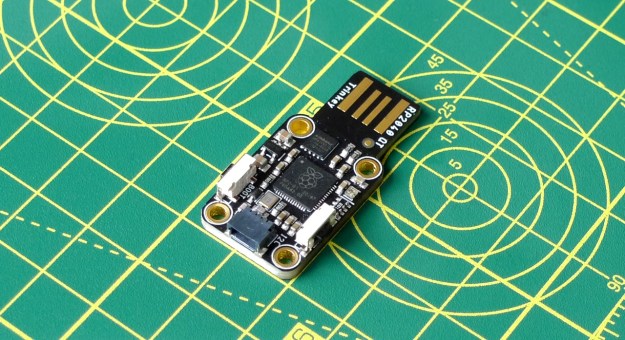
Adafruit’s RP2040 board connects to the host via an integrated USB-to-serial adaptor (Image © 2021, Tony Smith)
Adafruit’s RP2040 board connects to the host via an integrated USB-to-serial adaptor
Continue reading

Old tech for typing: using 1992’s Amstrad NC100 Notepad in 2025

In the early 1990s, I got to play with a new Amstrad device: the NC100 “notepad computer”. At the time, Amstrad was the name in British computer manufacturing. Notably it had shifted more than a million of its PCW series of word processors and while at this point it was pushing its line of IBM-compatible PCs, it hadn’t forgotten the success it had had with word processing kit.

The Amstrad NC100 (Image © 2025, Tony Smith)
Amstrad’s NC100: portable productivity

Enter the NC100, a mobile machine sporting a full size keyboard and a 480×60-pixel LCD used to render 80×8 characters. Pitched as a personal productivity tool, it shipped with on-board diary, calculator, address book, world time and spreadsheet applications as well as word processing software. Heck, it even included BBC Basic, in case you wanted to write your own programs on your daily commute.

Continue reading

How to get a 1990s palmtop communicating 2024-style: connect a Psion 3a to the Interweb

Recap I have acquired a UK-made Psion Series 3a palmtop. I’ve connected it to my Mac. I’ve connected it to my headless Pi server over serial. My next goal: connect the 3a to the Internet.

I never had any great expectations for getting the 3a online. To summarise the problem: the 3a shipped without integrated Internet support. And while it later received it, via the PsiMail email package, Internet access was predicated on a dial-up connection using a modem and an analogue phone line. It is possible to bridge this ancient approach to the modern world of always on broadband and WiFi, but yes, it’s a bit of PIA. Anyway, this is what you do.

Continue reading