
I managed to grab one of the first batch of these early — paid for with good money; not a ‘select few’ freebie — rather than the more obvious Raspberry Pi Pico 2. I’m pleased to say my choice was justified. This is a very good developer-centric RP2350-based board.

First, this is not a review of the latest piece of ‘Raspberry Silicon’ — we know that’s good. Instead, i’m looking at the host board only. Raspberry Pi has its own RP2350 board, the Pico 2, which is rather cheaper than Pimoroni’s: £4.80 to £12, but I suggest that the higher price is worth paying for all the extras the Pico Plus 2 includes. And, let’s face it, twelve quid is not a lot these days. You can’t buy two pints in London for that…
That additional £7.20 gets you a USB-C port, which is a much more convenient connector than the Pico 2’s archaic Micro-USB port. These days I always have USB-C cables to hand, and they’re just plain easier to remove and re-insert.

The board also sports a pre-fit SWD connector ready to take Raspberry Pi’s Debug Probe, so it’s ready for code loading and debugging. Additionally, there’s a Qwiic/Stemma QT connector (the Pico’s I2C0 on pins 4 and 5) to make it easier to hook up popular maker-oriented I²C and other peripherals.
That port’s presence doesn’t limit GPIO access: the Pico Plus 2 has the same pinout as the Pico and Pico 2, so it’s ready to be used as a plug in or solder on replacement for either board. Almost all add-ons are designed for the Raspberry Pi boards — such as the Kitronic breakout I use — and so aren’t usually usable with third-party boards. Here’s a third-party board that can make use of them all.
Also the board screenprint has all the GPIO pins clearly marked (see the pic above), which even Raspberry Pi has singularly failed to do.
I hook up displays and such using I²C, but if your project uses DVI or SPI, the Pico Plus 2 has a SP/CE connector on the underside. I have no cable for this, but it’s a feature I plan to investigate in the future.
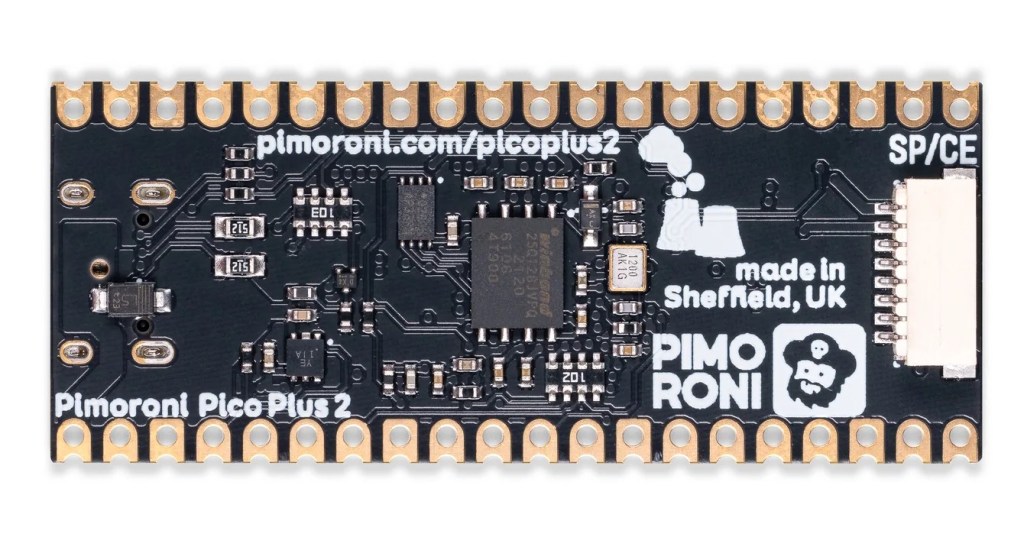
So for me, USB-C plus SWD plus a standard GPIO layout make the Pico Plus 2 a winner. The other ports are pure bonus. Likewise the 16MB of Flash (versus 4MB on the Pico 2) and an additional 8MB of RAM alongside the RP2350’s 520KB. There’s also a reset button, which I assume pulls the power from the microcontroller, but I’ve yet to confirm as Pimoroni hasn’t thus far published the board schematic.
The Pico Plus 2 is sold by Pimoroni. You can order/pre-order it here. It retails for £12 before P&P.
 smittytone messes with micros
“…not a review of the latest piece of ‘Raspberry Silicon’ — we know that’s good”. Hmmm — not sure that I would agree after perusing the serious and lengthy I/O errata list.
For your question about the reset button, the RP2040 and RP2350 both have a RUN pin that resets the MCU when pulled low. The Pico just doesn’t have a physical button attached to that pin, which Pimoroni adds.